
Engineered Combustion Systems Helps Food Manufacturers Hit Tight Thermal Profiles Without Overshoot
Overview Summary
- Tight thermal profiles depend on engineering, not guesswork — especially in food ovens and dryers where small temperature swings change moisture, color, and texture.
- Overshoot is often caused by upstream fuel-train instability, mismatched burners, or control loops reacting too fast or too late.
- Engineered Combustion Systems designs stable fuel trains, low-fire-reliable burners, and predictive controls that anticipate load changes rather than chasing them.
- Smart commissioning, repeatable startup curves, and clear cause-and-effect documentation lock in performance for the long term.
- With Engineered Combustion Systems equipment and control strategies, food manufacturers get predictable heating behavior that holds spec through startups, changeovers, and sanitation cycles.
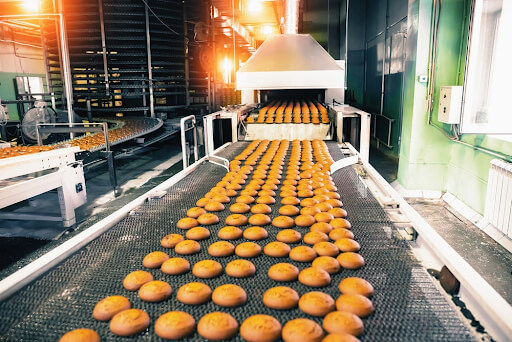 Maintaining a tight thermal profile in food production isn’t simply a matter of reaching the right temperature. Snack ovens, cereal dryers, and RTE (ready-to-eat) cook zones must hit precise thermal curves repeatedly, hour after hour, shift after shift. When even a single zone runs 10–12°F hotter for a few minutes, moisture levels shift. A startup overshoot can force corrective action that slows the entire line.
Many heating systems found in food facilities weren’t originally built to maintain these narrow tolerances while handling constant swings in product load, moisture, and conveyor speed. The result: unstable temperatures, drifting moisture curves, and operators constantly “chasing” the profile.
Engineered Combustion Systems helps food processors eliminate these problems by engineering systems that respond quickly, predictably, and consistently.
Fuel Trains Engineered for Stability — Before Overshoot Begins
Overshoot frequently starts upstream of the burner. When the fuel train reacts late, snaps open unexpectedly, or can’t hold lock-up pressure, the burner compensates aggressively, creating temperature swings.
Engineered Combustion Systems designs fuel trains with:
-
High-resolution pressure regulation
Stable droop characteristics and tight lock-up prevent sudden jumps in manifold pressure that cause firing-curve swings. -
Fast, predictable valve response
Burners in multi-zone ovens must respond in sync. Engineered Combustion Systems sizes valves and actuators so each zone reacts at the rate the control loop expects. No more “fast zones” and “slow zones.” -
Production-friendly leak-test logic
Instead of long, disruptive test cycles, Engineered Combustion Systems programs safety checks that run cleanly and reliably without causing startup temperature spikes.
Burners Selected for Low-Fire Stability, Not Just Capacity
Most food ovens spend the majority of the day operating in the lower third of their firing range. Many burners behave poorly there, struggling to hold flame stability or drifting in their air-fuel ratio.
Engineered Combustion Systems ensures burners support tight thermal control with:
-
Stable low-fire flame shape
Prevents hot-cold cycling and helps maintain moisture curves. -
Predictable air-fuel ratio control
Engineered Combustion Systems uses proven components (Maxon/Eclipse, Karl Dungs, etc.) that minimize drift and reduce the time maintenance teams spend re-tuning oxygen levels. -
Consistent ignition performance
Smooth, repeatable light-off helps avoid startup overshoot caused when zones ignite unevenly and PIDs overcorrect.
Combustion Controls That Anticipate Changes Instead of Reacting Late
Most drifting ovens aren’t failing thermally — they’re failing in their control logic. Engineered Combustion Systems builds custom combustion control strategies that match how the line actually behaves.
Engineered Combustion Systems control designs include:
-
PID loops tuned to real product load swings
A dryer running flour snacks doesn’t behave like one running fruit bars. Engineered Combustion Systems tunes to the product, not generic factory defaults. -
Feed-forward logic tied to conveyor speed and moisture
Instead of waiting for temperature to drift, firing commands adjust proactively based on incoming load and speed changes. -
Zone-to-zone communication
When one zone ramps up due to heavier incoming product, surrounding zones respond gradually, preventing the ripple effect that typically ends in overshoot.
Commissioning and Documentation That Lock in Performance
Even the best equipment won’t hold spec without structured commissioning. Engineered Combustion Systems treats the commissioning phase as an engineering service, not a trial-and-error exercise.
Engineered Combustion Systems supports long-term consistency with:
-
Startup curves matched to the product
Logging warm-up behavior allows Engineered Combustion Systems to set hard limits that prevent operators from inadvertently causing overshoot. -
Clear cause-and-effect tables
Every interlock and safety step is mapped so maintenance teams understand system behavior and resist the temptation to bypass devices. -
Reusable thermal profile validation
Engineered Combustion Systems provides before/after data that food safety and quality teams can keep on file for audits and compliance.
The Result: Repeatable Heating Without Overshoot
When these strategies are combined, food manufacturers gain:
- Stable color and moisture across SKUs
- Faster recovery after sanitation or downtime
- Reduced scrap during changeovers
- Temperature control that doesn’t oscillate or drift
- Far less manual tuning for maintenance
- Operators who trust the oven because it behaves consistently
Food plants don’t need heroic operators to hold thermal profiles, they need equipment and controls engineered for real-world production. That’s exactly where Engineered Combustion Systems delivers value.
Engineered Combustion Systems Solutions for Precise, Repeatable Thermal Profiles
Toward the end of the process, Engineered Combustion Systems combines engineering insights with purpose-built equipment such as:
- Gas Trains designed for tight pressure stability
- Combustion Control Panels with product-specific logic and feed-forward tuning
- Pressure Reducing Stations and Metering Stations configured for predictable supply behavior
These systems give food manufacturers the confidence that every startup, every shift change, and every product run will perform the same way, without temperature overshoot.
Ready to Improve Thermal Stability in Your Oven or Dryer?
If your cereal dryer, snack oven, or RTE system struggles with overshoot, drift, or inconsistent moisture curves, Engineered Combustion Systems can help you redesign the fuel train, controls, and airflow for reliable, repeatable heating.
Contact Engineered Combustion Systems to discuss your thermal profile challenges or request a system evaluation.